How Has Technology Changed Research in 2026
How Has Technology Changed Research is a question that defines the modern era of discovery. Imagine a scientist spotting a new planet using a smartphone app rather than a giant telescope. What was once confined to dusty libraries, handwritten notes, and manual experiments has now evolved into a world of cloud computing, artificial intelligence, and global collaboration. Technology has not only accelerated the pace of innovation but also reshaped how we question, analyse, and share knowledge.
Today, research is faster, more connected, and powered by data on an unprecedented scale. From virtual simulations that predict climate change to AI models decoding the human genome, the possibilities seem limitless. This article explores the major shifts that have revolutionised research, supported by real examples and statistics, and offers insight into how these advancements continue to redefine the boundaries of what humanity can discover.
Core Technology & Background Analysis
To understand how technology has changed research, it helps to unpack the core concepts behind today’s tools and platforms. At the heart of modern research are three interlocking pillars: computational power, data infrastructure, and intelligent algorithms. High‑performance computing (HPC) clusters and cloud services provide virtually on‑demand processing capability, allowing researchers to run simulations and analyses that would have taken months on a single desktop machine. Cloud platforms—offered by providers such as AWS, Microsoft Azure, and Google Cloud Platform—host datasets, virtual machines, and collaboration environments, making it possible for global teams to work on the same project in real time without maintaining their own physical servers.
On top of this infrastructure sits big data technology: distributed storage systems, parallel databases, and data pipelines designed to handle terabytes or petabytes of information. These systems enable the integration of diverse data sources—sensor readings, genomic sequences, satellite imagery, social media streams—into unified repositories that can be queried and analysed at scale. Layered over this is artificial intelligence (AI) and machine learning (ML). These techniques move beyond traditional statistics by allowing models to learn complex patterns from examples rather than explicit rules. Deep learning, a subset of ML that uses multilayer neural networks, has been especially transformative in fields like image recognition, natural language processing, and protein folding.
Equally important is the software ecosystem that scaffolds research. Tools such as electronic lab notebooks (ELNs), version control systems like Git, interactive coding environments like Jupyter Notebook, and workflow automation frameworks allow scientists to document methods, track changes, share code, and reproduce results far more reliably than in the past. Real‑time collaboration platforms and open‑access repositories have turned research from a series of isolated efforts into a networked activity, where preprints, datasets, and code are shared early and iterated on collectively. Underpinning everything is a growing emphasis on research integrity and security: encryption, access control, privacy‑preserving analytics, and algorithmic auditing aim to ensure that this powerful technical stack is used responsibly and ethically. Together, these technologies form the backbone of twenty‑first‑century research—faster, more transparent, more collaborative, and more deeply computational than ever before.
From Manual to Digital: The Shift in Research Methods
Early Tools vs. Modern Software
The transition from manual note-taking to advanced digital systems represents one of the most transformative changes in modern research. Traditionally, scientists relied on handwritten journals, printed references, and physical archives to record their findings. These methods were time-consuming, prone to human error, and limited by accessibility. Today, research has entered a new era of automation, precision, and speed driven by artificial intelligence, machine learning, and cloud computing.
Key developments that illustrate this shift include:
- Digital Record-Keeping: Researchers now use electronic lab notebooks (ELNs) and cloud databases that allow instant data storage, retrieval, and sharing across teams and institutions.
- AI Integration: Machine learning algorithms assist in sorting and categorising research data automatically, identifying patterns that would take humans years to uncover.
- Cloud Collaboration: Cloud-based platforms have replaced local drives, enabling real-time editing, automatic backups, and cross-border teamwork.
- Data Security and Accessibility: Modern encryption and access controls protect sensitive data while ensuring it remains available to authorised users anywhere in the world.
According to Gartner, by 2025, 85 percent of researchers will use cloud tools daily to manage and analyse their work. This shift is exemplified by organisations like NASA, which now uses high-fidelity simulation software to design and test spacecraft virtually. These simulations reduce physical testing costs and shorten development cycles, proving how digital tools have replaced manual methods at the highest level of scientific research.
Automation in Experiments
Automation has become a cornerstone of laboratory innovation, transforming how experiments are conducted and managed. Where once researchers manually measured, mixed, and tested materials, today’s labs are driven by robotics, smart sensors, and automated workflows that perform these repetitive or hazardous tasks with high accuracy.
Key aspects of automation in research include:
- Robotic Laboratory Systems: Robots can conduct repetitive testing, mix chemicals, and prepare samples, ensuring consistent quality and freeing scientists for higher-level analysis.
- Smart Workflow Integration: Automated scheduling and data logging tools streamline laboratory management, reducing administrative workloads.
- Error Reduction: Dr. Elena Ruiz, a leading biotech expert, states that “automation cuts errors by 40 percent,” improving both reliability and reproducibility of results.
- Accessible Automation Tools: Beginners can start with simple, open-source platforms such as Jupyter Notebook, which allow coding and automation of data analysis tasks without significant cost.
- Scalable Solutions: From small research groups to major pharmaceutical companies, automation scales efficiently, allowing all to benefit from reduced time and resource expenditure.
By minimising manual handling and increasing data accuracy, automation empowers researchers to innovate faster and with greater confidence in their results.
Real-Time Data Tracking
Real-time data collection has become a vital component of modern research, offering instant insights and adaptive responses that were once impossible. With the integration of sensors, wearables, and mobile applications, scientists can now monitor experiments, subjects, or environmental conditions continuously and remotely.
Key advantages of real-time tracking include:
- Instant Feedback: Data is transmitted live, allowing researchers to adjust experiments immediately rather than waiting for post-trial analysis.
- Remote Monitoring: Researchers can oversee long-term studies or field experiments from any location using secure apps or online dashboards.
- Improved Accuracy: Continuous monitoring reduces human error and captures fluctuations that static measurements might miss.
- Scalable Health and Environmental Studies: During the COVID-19 vaccine trials, wearable devices were used to collect vital data such as heart rate and temperature, speeding up patient monitoring and vaccine assessment.
- Integration with AI Systems: Real-time data streams can feed directly into machine learning models for ongoing analysis and prediction.
This approach has revolutionised how data is gathered, interpreted, and acted upon. Instead of working with delayed or incomplete results, researchers now operate with live insights that lead to quicker and more informed decisions.
Boosting Data Power: Analysis and Insights
Big Data and Machine Learning
When examining How Has Technology Changed Research, the influence of big data and machine learning stands at the forefront. Modern research now relies on processing enormous volumes of data that would have been impossible to handle manually. Algorithms and artificial intelligence systems can analyse millions of variables in seconds, revealing insights and relationships that were previously invisible.
The Nature journal reports that research output has increased tenfold since 2000 due to advances in machine learning and computational analysis. This acceleration has not only enhanced productivity but also raised the quality and precision of results across scientific fields.
Some key ways big data and machine learning have transformed research include:
- Massive Data Integration: Scientists can now merge data from multiple sources—such as satellites, sensors, social media, and clinical trials—to build unified, comprehensive datasets.
- Automated Pattern Recognition: Machine learning algorithms detect correlations and trends far faster than traditional analysis, supporting breakthroughs in areas like genomics, economics, and climate science.
- Enhanced Predictive Accuracy: By learning from past data, AI models improve continuously, producing increasingly accurate predictions over time.
- Error Detection and Data Cleaning: Automated systems flag anomalies or inconsistencies, improving data reliability and reducing manual correction efforts.
- Resource Efficiency: Big data tools optimise experiment design by identifying the most impactful variables, helping researchers save time, money, and materials.
A defining example of this transformation is Google’s DeepMind, which developed an AI system capable of predicting protein structures with near-perfect precision. This achievement has revolutionised biological research, paving the way for faster drug discovery and better understanding of genetic diseases.
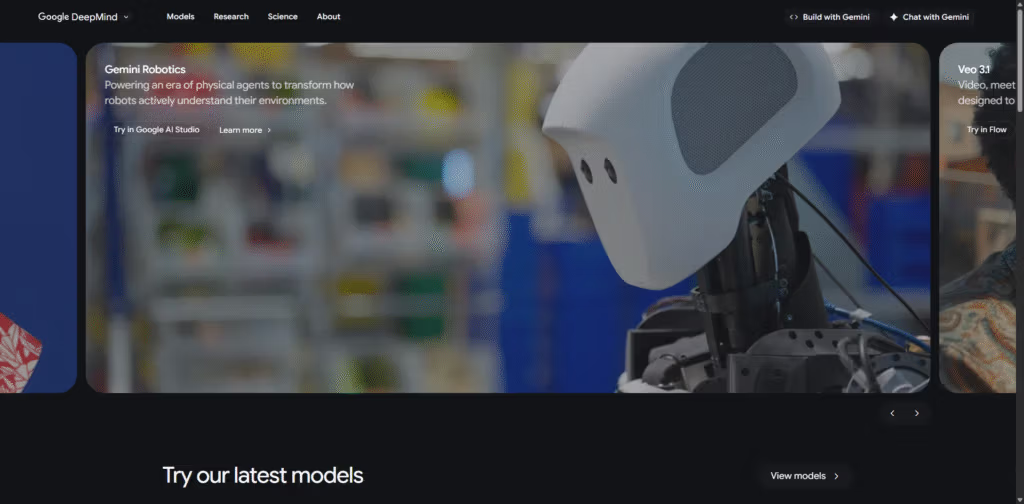
Machine learning is no longer a specialist’s tool but a standard research instrument across multiple domains. From healthcare and physics to social sciences and environmental studies, its ability to analyse vast datasets continues to reshape how scientists explore and interpret the world.
Visualization Tools
Visualisation has become a crucial bridge between complex data and human understanding. Even the most advanced analyses lose impact if their results cannot be clearly communicated. Modern visualisation tools transform intricate datasets into accessible, interactive, and engaging visuals that reveal underlying trends and patterns.
Data expert Mark Chen aptly notes that “visuals make complex data clear.” Through dynamic charts, heatmaps, and dashboards, visualisation platforms empower researchers to interpret data faster and share their findings effectively with both experts and the public.
Key advantages and uses of modern visualisation tools include:
- Enhanced Comprehension: Turning numerical data into visual representations helps identify trends and anomalies instantly.
- Interactive Dashboards: Platforms such as Tableau, Power BI, and Google Data Studio allow real-time manipulation of data, letting users explore scenarios dynamically.
- Cross-Disciplinary Communication: Visuals help researchers from different fields understand shared datasets without requiring deep technical expertise.
- Improved Transparency: Clear visuals increase confidence in findings and promote open, verifiable research.
- Educational Impact: Graphical tools support better learning and engagement when presenting findings to students or non-specialist audiences.
An actionable takeaway for researchers is to use free trials of these platforms to begin incorporating data visualisation into their projects. A simple interactive chart can often communicate more insight than pages of raw data tables.
Predictive Modelling
Predictive modelling is one of the most powerful applications of technology in research. By using historical data, statistical algorithms, and artificial intelligence, researchers can forecast outcomes and simulate scenarios with impressive accuracy. This approach has become essential in disciplines that require anticipation of complex phenomena, from finance and medicine to meteorology and public health.
Core aspects of predictive modelling include:
- Data-Driven Forecasting: Models use large datasets to estimate future events or outcomes, helping to inform decisions and policies.
- AI and Neural Networks: Deep learning systems refine their predictions by identifying intricate relationships that humans cannot easily detect.
- Scenario Simulation: Researchers can run multiple what-if analyses to test variables before conducting real-world experiments.
- Policy and Planning Applications: Predictive tools guide government and corporate strategies by modelling economic, environmental, or social impacts.
- Validation and Accuracy: Continuous model testing and refinement ensure predictions remain reliable as new data becomes available.
For instance, climate researchers employ artificial intelligence to simulate global weather systems with unprecedented precision. These predictive models help governments prepare for extreme events, allocate resources, and craft long-term sustainability strategies. The integration of predictive analytics not only enhances foresight but also supports proactive, evidence-based decision-making in nearly every scientific field.
Deep Configuration Analysis: What Today’s Tech Stack Enables Researchers to Do
Beyond broad trends, the real impact of technology is felt in the practical “configuration” of tools, skills, and workflows that individual researchers now assemble. A typical modern research stack might combine:
- a mid‑range laptop or workstation,
- cloud compute instances from providers like DigitalOcean or Linode (Akamai),
- a Python/R environment with libraries for statistics and machine learning,
- a version-controlled codebase on Git,
- and shared cloud storage for data and documentation.
Even this modest setup is powerful enough to run serious research projects. For example, a social scientist can stream social media data into a cloud database, use natural language processing models to detect sentiment or misinformation patterns, and then visualise trends in an interactive dashboard—all without owning a physical server. In the life sciences, a lab with automated pipetting robots and ELNs can produce high‑throughput experiments, feed the resulting data into cloud‑hosted ML pipelines, and validate findings with replication scripts that collaborators can execute anywhere in the world.
This configurability has consequences for scope and scale. A single PhD student can now do work that previously required a dedicated institutional computing centre: run Monte Carlo simulations, train custom machine learning models, or analyse thousands of samples. Hardware and software advances also reduce barriers between disciplines; a climate modeller and an economist can use the same statistical libraries and cloud services while asking entirely different questions. However, this power demands good practices. Poorly documented code, untracked datasets, or unvalidated models can turn a sophisticated stack into a fragile one. That is why concepts like reproducible workflows, containerisation (e.g., Docker), automated testing, and data versioning are increasingly seen as “baseline configuration” for credible research. Put simply, the new stack lets researchers move from small, isolated experiments to integrated, scalable, and shareable projects—provided they pair technical horsepower with rigorous methodology.
Connecting Minds: Collaboration Across Borders
Online Platforms for Teamwork
The question How Has Technology Changed Research is also reflected in the way collaboration now transcends physical boundaries. Once limited by geography, researchers today can form global teams with ease through digital communication tools and shared online environments. Platforms like Slack, Zoom, and Microsoft Teams enable seamless interaction, while project management tools keep workflows aligned.
Key features of online teamwork include:
- Instant Communication: Video calls, chat platforms, and discussion boards maintain constant dialogue across time zones.
- Shared Resources: Cloud-based repositories allow teams to upload and access files securely in real time.
- Efficient Coordination: Tools such as Trello and Asana manage project timelines, milestones, and task delegation.
- Inclusive Collaboration: Virtual spaces reduce travel costs, making participation possible for researchers from developing nations.
- Rapid Dissemination: Findings can be shared with partners instantly, cutting months off traditional publishing cycles.
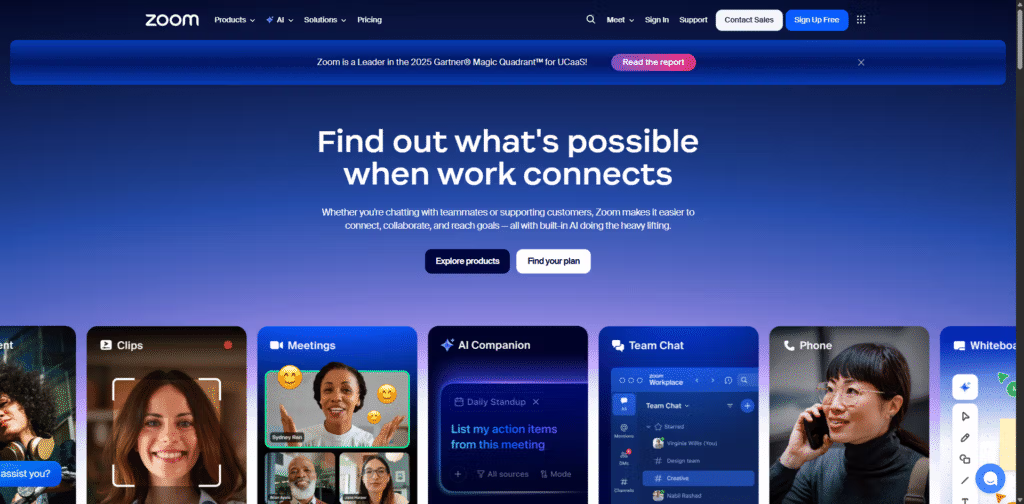
A UNESCO report reveals that 70 percent of researchers now collaborate internationally using digital means. A major example is the Human Genome Project, which achieved unprecedented progress through global online cooperation and shared data resources. This model has since become the gold standard for large-scale scientific collaboration.
Open Access and Sharing
The open-access movement has fundamentally transformed how research is published and shared. Rather than being locked behind costly subscription barriers, scientific knowledge is now more freely available through online journals and repositories.
As Professor Liam Patel, an open science advocate, explains, “Open data doubles discovery speed.” When information flows without restriction, researchers can build upon each other’s work faster, reducing duplication and accelerating breakthroughs.
Benefits of open access include:
- Wider Reach: Studies are accessible to scientists, educators, and the public without paywalls.
- Faster Innovation: Researchers can immediately use findings to inspire new ideas and experiments.
- Enhanced Transparency: Open data promotes accountability and trust in scientific results.
- Global Inclusion: Institutions in lower-income regions gain access to resources previously out of reach.
- Networking Opportunities: Publishing on platforms such as arXiv.org increases visibility and fosters new collaborations.
This growing culture of sharing has reshaped the speed and inclusivity of research worldwide, ensuring that knowledge circulates freely across borders and disciplines.
Virtual Conferences and VR Meetings
Immersive technology has introduced an entirely new way for researchers to meet, discuss, and collaborate. Virtual conferences, supported by VR (Virtual Reality) and AR (Augmented Reality), allow scientists to attend presentations, explore 3D data environments, and network globally without leaving their desks.
Highlights of this trend include:
- Accessibility: Scholars from different countries can participate without the cost or environmental impact of travel.
- Interactivity: Attendees can explore digital posters, participate in live Q&A sessions, and interact in virtual exhibition halls.
- Scalability: Virtual spaces can host tens of thousands of participants simultaneously.
- Inclusivity: These platforms provide opportunities for researchers who might otherwise face logistical or financial barriers to attendance.
- Engagement: Immersive 3D experiences make academic events more interactive and memorable.
In 2025, a global AI summit held entirely in virtual reality attracted 50,000 participants from around the world. This milestone demonstrates how technology is dissolving physical boundaries and democratising access to knowledge exchange.
Hurdles and Fixes: Navigating Tech’s Downsides
While technology has transformed research in remarkable ways, it also introduces new challenges that must be managed carefully. As digital tools become more integrated into every stage of research, issues such as data privacy, algorithmic bias, and unequal access continue to pose significant risks. Addressing these challenges is essential to ensuring that the benefits of innovation are both ethical and inclusive.
Data Privacy Issues
The increasing digitisation of research data has created new vulnerabilities in security and privacy. As vast amounts of sensitive information—from genetic records to clinical trial data—move online, researchers face growing risks of breaches and misuse. Cybersecurity Ventures reported that in 2024, 60 percent of all data breaches affected research institutions. These breaches can compromise not only personal information but also the credibility of entire studies.
Key concerns surrounding data privacy in research include:
- Insufficient Encryption: Weak encryption methods can expose sensitive data to hackers or unauthorised access.
- Third-Party Risks: Cloud storage providers and collaborative platforms may have varying levels of security, putting shared data at risk.
- Regulatory Compliance: Failure to follow privacy laws, such as the General Data Protection Regulation (GDPR), can result in heavy fines and reputational damage. A notable case involved a European Union health study penalised for poor data encryption.
- Data Ownership and Consent: Questions remain over who controls research data and how it can be ethically shared or reused.
- Insider Threats: Security lapses can also occur within institutions, often due to poor access controls or unintentional employee actions.
To mitigate these risks, researchers are urged to adopt strict data governance policies, utilise secure encryption methods, and train staff on cybersecurity best practices. Implementing multi-factor authentication, regular audits, and secure cloud systems are essential steps in protecting sensitive research data.
Bias in Algorithms
Although artificial intelligence enhances efficiency, it can also perpetuate or even amplify existing biases present in datasets. When algorithms are trained on incomplete, unbalanced, or historically biased data, they may produce skewed outcomes that misrepresent real-world conditions. As ethicist Sara Kim warns, “We must audit code for fairness.”
Understanding and reducing bias in research technologies involves several key actions:
- Dataset Quality Checks: Ensure that datasets represent diverse populations or variables relevant to the research topic.
- Algorithmic Transparency: Document how algorithms make decisions to identify potential points of bias.
- Fairness Testing Tools: Use open-source resources such as Fairlearn or AI Fairness 360 to evaluate algorithmic bias.
- Cross-Disciplinary Review: Involve ethicists and social scientists to assess the broader implications of automated decision-making.
- Continuous Monitoring: Bias detection should not be a one-time task but an ongoing part of model evaluation.
Unaddressed bias can have serious consequences, particularly in areas like healthcare, recruitment, and criminal justice research. Establishing a clear ethical framework helps ensure that technology serves as a tool for fairness and accuracy rather than distortion.
Digital Divide in Access
While some institutions thrive with cutting-edge digital resources, others struggle to gain access to even basic research technologies. This digital divide is most pronounced in developing regions, where limited funding, infrastructure, and connectivity hinder progress. Without equitable access, global research risks becoming dominated by a small number of well-funded nations and corporations.
The main challenges contributing to this divide include:
- Funding Disparities: Wealthier institutions can afford advanced technologies, leaving smaller labs behind.
- Infrastructure Gaps: Slow internet connections and outdated hardware reduce research efficiency.
- Training Deficits: Many researchers lack formal education in data analysis, AI, or digital tools.
- Limited Access to Journals: Paywalls still restrict knowledge-sharing for many institutions.
- Dependence on External Support: Developing countries often rely on international collaborations for access to technology.
However, progress is being made. Global initiatives and targeted grants are helping to close this gap. For instance, several African research centres have received technology funding that increased local study output by 30 percent, allowing regional scientists to lead projects that were once beyond reach. Continued investment in digital literacy and affordable infrastructure is essential to ensure inclusivity in the global research landscape.
Buying Guide: Choosing the Right Tech Stack for Your Research
Technology has changed research, but not every researcher needs the same tools. Your ideal setup depends on your discipline, budget, and technical skills. Below is a practical guide to matching your needs with the right kind of infrastructure.
1. For Individual Researchers and Small Labs
If you are a solo researcher, graduate student, or part of a small team, you likely need:
- A reliable laptop or desktop with enough RAM (16–32 GB) for local analysis.
- Access to cloud compute for heavier workloads.
- Version control (Git/GitHub), Jupyter or RStudio, and a basic data‑visualisation toolkit.
Cloud providers like DigitalOcean or Vultr balance cost and performance. They allow you to spin up virtual machines for short, intensive tasks (e.g., training an ML model) and shut them down when idle, so you only pay for what you use.
2. For Data‑Heavy or AI‑Driven Projects
If your work involves large datasets, deep learning, or complex simulations, you need:
- Scalable storage and compute clusters.
- GPU-enabled instances for model training.
- Robust backup and security policies.
In this scenario, global cloud platforms such as AWS or Google Cloud Platform are strong choices because they offer specialised AI services, managed databases, and tooling for MLOps. You gain access to high-end hardware without buying it outright.
3. For Teaching, Training, and Collaborative Projects
For educators or teams focused on training new researchers, prioritise:
- Easy‑to‑use web interfaces (e.g., hosted JupyterHub).
- Shared drives and collaborative editing.
- Integrated user management and role-based access.
Managed hosting providers like Cloudways or SiteGround can be helpful when you want to deploy web apps, dashboards, or learning platforms without managing low‑level infrastructure.
4. Strategic Alternative Recommendations
Depending on your priorities, you might consider:
- Cost‑conscious research teams – RackNerd offers budget-friendly VPS plans that are often sufficient for lightweight analytics, small databases, or hosting documentation and tools.
- Environmentally aware or growth‑stage groups – Kamatera provides flexible, hourly billed cloud servers that can be scaled up or down as your computational needs evolve, making it ideal for projects that grow in complexity over time.
When choosing your stack, keep three questions in mind:
- What is my typical workload? (short bursts of heavy compute vs. constant low‑intensity use)
- How important is scalability and uptime? (personal project vs. multi-institution collaboration)
- What level of technical management can I handle? (do you want full control, or a managed service?)
Aligning your answers with the right provider and tools ensures that technology accelerates your research instead of getting in the way.
Looking Ahead: Tech’s Role in Tomorrow’s Research
AI as a Research Partner
Artificial intelligence is rapidly evolving from a supporting tool to an active collaborator in research. Instead of merely processing data, AI systems are beginning to design experiments, generate hypotheses, and even write preliminary research drafts. According to McKinsey, by 2030, AI will handle 50 percent of routine research tasks, freeing human researchers to focus on creativity, strategy, and ethical considerations.
Some examples of AI’s expanding role in research include:
- Automated Literature Review: AI scans thousands of papers to summarise relevant findings.
- Hypothesis Generation: Algorithms can suggest new avenues for experimentation based on prior results.
- Experimental Design: AI tools simulate potential outcomes before physical testing, saving time and resources.
- Quantum Computing: Emerging systems combine quantum processing with AI to accelerate drug discovery and materials research.
- Human-AI Collaboration: Researchers work alongside AI models that adapt and improve based on their feedback.
This evolution positions AI not just as a computational assistant but as a partner capable of transforming how research is conceived and executed.
Sustainable Tech Practices
As research becomes more data-intensive, sustainability has become a pressing issue. High-performance computing, cloud storage, and large-scale simulations require immense energy consumption, which can contribute to environmental impact. Balancing innovation with ecological responsibility is now essential.
Green technology practices are emerging to address this, including:
- Energy-Efficient Data Centres: Using renewable energy sources to power cloud servers.
- Carbon-Neutral Research Tools: Companies developing AI are now designing systems that offset their energy usage.
- Eco-Friendly Cloud Services: As green tech specialist Nora Lee explains, “Eco-friendly servers cut energy use,” helping reduce institutional carbon footprints.
- Remote Collaboration: Minimising travel for conferences and meetings lowers overall emissions.
- Sustainable Hardware: Encouraging recycling and responsible sourcing of materials for research equipment.
By choosing low-power cloud services and prioritising sustainable software solutions, researchers can help reduce environmental strain while maintaining high productivity. Sustainability and technology can advance hand in hand if guided by responsible design and conscious choices.
Personalised Learning Paths
The future of research also depends on how effectively scientists and scholars continue to learn and adapt. Technology now enables personalised learning paths that tailor educational content to an individual’s progress, needs, and goals. Artificial intelligence analyses user performance and adjusts materials accordingly, ensuring efficient and focused skill development.
Key features of adaptive learning systems include:
- Data-Driven Customisation: Platforms like Coursera and edX analyse engagement and performance data to adjust course difficulty.
- Flexible Learning: Researchers can learn new tools and methods at their own pace, integrating study with ongoing projects.
- Skill Enhancement: Continuous learning ensures researchers stay up to date with rapidly evolving technologies such as machine learning, data analytics, and computational modelling.
- Certification and Recognition: Online learning provides official credentials that support academic and professional growth.
- Community Collaboration: Learners can connect with global peers, discuss ideas, and collaborate on shared interests.
In a world where research methods evolve daily, adaptive learning ensures that scientists remain innovative, relevant, and ready for the challenges ahead.
Together, these trends suggest that the next phase of research will be defined not only by technological power but by how responsibly and inclusively that power is used.
Frequently Asked Questions (FAQ)
1. How has technology most significantly changed day-to-day research work?
Technology has streamlined nearly every stage of the research lifecycle: literature discovery, experiment design, data collection, analysis, collaboration, and publication. Tasks that once required weeks—such as scanning archives or running large simulations—can now be automated or executed in hours using cloud computing, AI-driven analytics, and digital collaboration platforms.
2. Do I need advanced coding skills to benefit from modern research technology?
Not necessarily. While programming skills in languages like Python or R unlock the full power of modern tools, many platforms now offer low-code or no-code interfaces. Visual pipeline builders, drag‑and‑drop analytics dashboards, and user-friendly ELNs allow non-programmers to perform complex analyses. However, gaining at least basic coding literacy is increasingly advantageous.
3. Is AI replacing human researchers?
AI is augmenting, not replacing, human researchers. It excels at routine, repetitive, and large-scale pattern-recognition tasks, such as screening compounds or scanning the literature. Humans remain essential for framing questions, interpreting results, making ethical judgments, and understanding context. The most productive setups treat AI as a partner that handles the heavy lifting while humans guide direction and meaning.
4. How can researchers protect sensitive data when using cloud services?
Researchers should adopt a layered security approach: encrypt data at rest and in transit, use providers with strong compliance certifications, apply strict access controls and multi-factor authentication, and conduct regular security audits. Sensitive datasets may be anonymised or pseudonymised before upload, and data-processing agreements should clearly define responsibilities between institutions and cloud vendors.
5. What can be done to reduce the digital divide in research technology?
Addressing the digital divide requires coordinated efforts: funding for infrastructure (reliable internet, modern hardware), training programmes in digital skills and data science, broader adoption of open-access publishing, and partnerships between well-resourced and under-resourced institutions. Choosing affordable, flexible platforms—such as budget-friendly cloud VPS providers or open-source software—also helps make modern research tools more accessible globally.
Conclusion
The question How Has Technology Changed Research is no longer one of speculation but of lived reality. The transformation is visible in every discipline, from astrophysics to social science. What was once limited by time, geography, and manual effort has evolved into a networked, data-driven ecosystem that thrives on collaboration, automation, and artificial intelligence.
To researchers, this technological evolution is both an opportunity and a responsibility. The tools now available can accelerate discovery beyond imagination, yet they demand critical oversight, ethical awareness, and an ongoing commitment to transparency. As data grows larger and algorithms more complex, the integrity of research will depend on how carefully you manage privacy, reduce bias, and ensure equal access to these innovations.
The future of research will not be defined solely by speed or volume but by purpose. Technology must remain a partner that amplifies curiosity, creativity, and collaboration—not one that replaces them. Whether you are developing a new model, analysing global datasets, or mentoring the next generation of scholars, the call is clear: harness these tools wisely, question their outcomes rigorously, and share your knowledge openly.
The next era of discovery belongs to those who blend human insight with digital intelligence. Use the power of technology not just to accelerate research, but to expand its reach, deepen its impact, and ensure that the pursuit of knowledge continues to serve humanity as a whole. If you found this article useful, you can also check out Free AI Tools for Research Writing for a curated list of the best free AI tools to support your research and writing.